
The steps are simple. What happens inside each one is not.
Professionals working in complex organisations rarely fail because their ideas are wrong. They fail because the human system their ideas have to move through is more resistant, more complicated, and less predictable than any business case accounts for.
The Strategic Influence Process was developed to address that gap directly. It is a sequence of six steps that provides a structured way to think through any goal that depends on the agreement, support, or at minimum the non-interference of people with the power to determine its outcome.
The process does not simplify the human system. It makes it legible. And from legibility, strategy becomes possible.
Where this process applies
The Strategic Influence Process is not a tool for every situation. It is designed for goals with a longer time horizon, genuine complexity, and opposition from multiple directions.
A goal is well suited to this process when it requires many people to think, feel, or act differently by the time it is achieved. When it faces real opposition or competing priorities that will test the approach over months rather than days. When it sits at the heart of the current role rather than at its edges.
A goal that only needs one person to say yes does not require this, unless that person is hard to access and very senior. Neither does one that could be resolved in a single meeting, or one where the logic of agreement is straightforward and uncontested.
Applied to the wrong situation, the process adds friction without value. Applied to the right one, it provides the only kind of structure the situation can actually hold.
The six steps
The process moves through six interdependent steps. Each one builds on what the previous step reveals. Each one is revisited as conditions change.
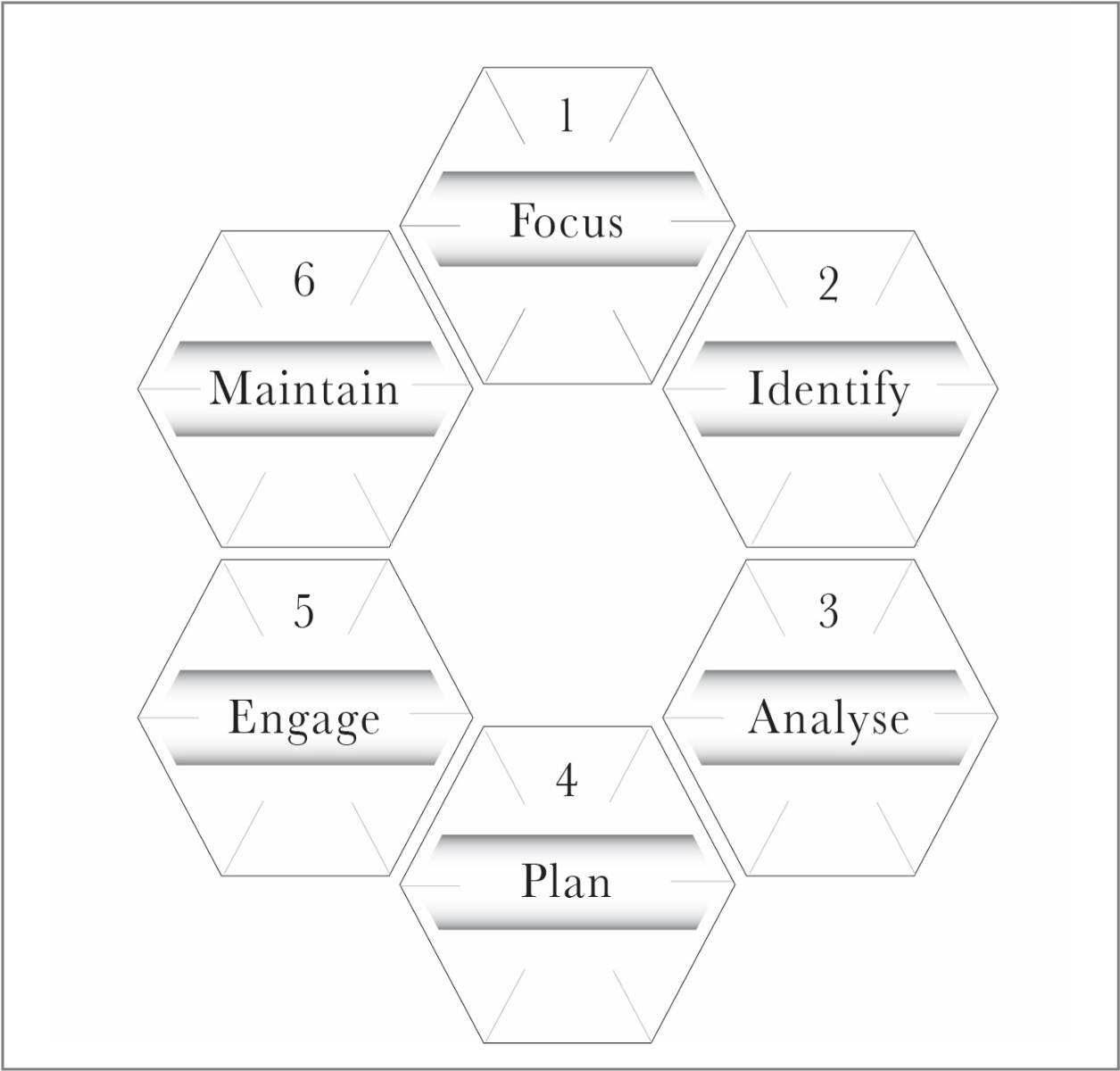
Focus. The influencing goal must be defined with precision before anything else can be determined. A vague goal produces a vague strategy. Focus means identifying what specifically needs to happen, grounded in the purpose, values, and objectives of the organisation it serves, and what success looks like when it arrives.
Identify. Not every stakeholder carries equal weight. This step surfaces who can have the greatest impact on the outcome, positively or negatively, including those who have not yet been considered and those who may not appear significant until the moment they act.
Analyse. Each significant stakeholder carries their own interests, motivations, current position, and potential for movement. Understanding these with precision is what makes subsequent engagement effective rather than generic. The questions that matter here are simple: what does this person want to achieve, what is their history with this kind of proposal, and why are they positioned where they are?
Plan. The analysis generates a strategy. Not a single strategy applied uniformly, but a differentiated approach for each significant stakeholder, sequenced to build cumulative momentum and designed to address resistance before it hardens into opposition.
Engage. This is where the process becomes visible in practice. The quality of the conversations, the precision of the framing, and the ability to adapt in real time as the stakeholder environment responds. Engagement is not a single event. It is a sustained series of moves informed continuously by what each interaction reveals.
Maintain. Stakeholder environments shift. Alignment secured at one point can erode as conditions change, as other actors move, and as competing priorities emerge. Maintain means returning to the process continuously, not treating it as a plan executed once and filed.
What the process does not tell you
The six steps are a map of the territory, not a guide to every decision within it. What each step requires in a specific situation, how to read a stakeholder whose position is ambiguous, how to sequence engagement when the political terrain is contested, how to rebuild momentum when resistance has already hardened: none of that is contained in the step names.
That is not a limitation of the process. It is the nature of the work. The process creates the structure within which judgement operates. It does not replace judgement.
The heritage of this approach
The Strategic Influence Process is a contemporary reframing of the Stakeholder Influence Process, first published in 2008 and developed from research and practice at the intersection of influence, power, and organisational politics. The six steps have remained structurally consistent across nearly two decades of application in complex organisations. What has changed is the environment they operate within and the ethical standard the current moment demands.
The original process helped professionals identify who was onside and who was not, develop strategies to build genuine alignment, and uncover opportunities for collaboration that had previously been overlooked. That core logic holds. It has simply become more urgent.
Colin Gautrey, June 2026
Colin Gautrey has been developing and applying ethical influence, strategic influence, and organisational politics since 2003.
Ethical Strategic Influence
High-integrity influence that gets real results.
You are good at what you do. You know it. The people around you know it.
Defining Strategic Influence: A Deliberate Process for Complex Organisations, 2026-06-21, GI, Influence
Most influence fails before it begins. The reason is almost always the same.
Strategic influence is not persuasion with better preparation. It is a structured discipline with a precise definition, and most professionals have never encountered either.
The Five Rules of Ethical Influence
Strategic influence today demands a higher standard than most professionals are currently meeting.
Influence is not neutral. Every attempt to shape a decision carries an ethical dimension that most professionals prefer not to examine too closely. In the current environment, that reluctance has a cost.